SKANALYTIX INSIGHTS
What Information Should the State of a Financial Market Model Contain?
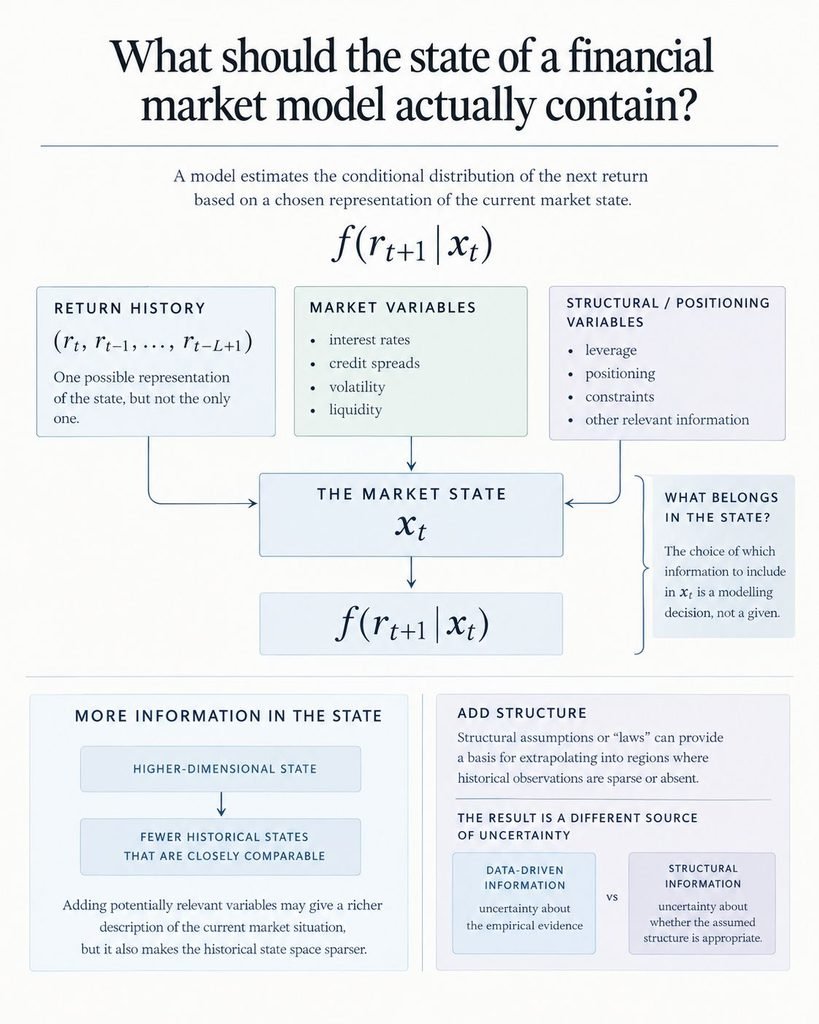
Suppose we want to estimate the conditional distribution of the next return, f(r[t+1]), given the current state x[t]. What information should x[t] capture?
Different modelling approaches make different choices. The state could include the recent history of returns, interest rates, credit spreads, liquidity, leverage, positioning, or many other variables. Other models introduce latent variables to represent unobserved aspects of the market, while some build more structure into the model by making assumptions about how the system evolves.
Adding variables gives us a richer description of the current state, but it also increases its dimensionality. Historical observations that were reasonably comparable may become much less so as we add dimensions, leaving less historical data to support reliable estimation of the conditional distribution.
So there is a trade-off between how much information we include in the state and how much empirical support we have for estimating the distribution conditional on that state.
There is another way to deal with sparse regions of the historical data: add more structure to the model by making assumptions about how the system evolves. This gives us a basis for extrapolating beyond what has been observed, but introduces uncertainty about whether those assumptions are appropriate.
Perhaps the fundamental question is not how much information we can put into the state, but what information is actually useful for the modelling objective, given the data available to us.